
You know that moment when you’re reading a student’s writing and you have to take a little pause because…well…there are commas everywhere?
Or maybe there aren’t any commas at all. 😂
Teaching kids to use commas can sometimes feel like one of those grammar skills that should be simple—but somehow gets a little tricky once they start putting pencil to paper.
And let’s be honest. Kids have plenty of things to think about when they’re writing. Capital letters. Spelling. Complete sentences. Making sure their story actually makes sense. And now we want them to remember where to put those tiny little commas, too?
It can feel like a lot. Here are some fun ideas for using commas in your classroom!
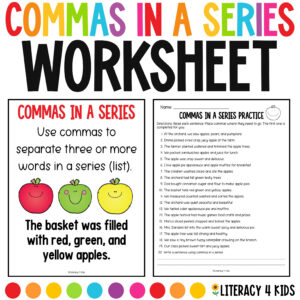
Commas in a Series Freebie
Here’s a freebie for you in our Free Resource Library. If you’re not already a member, click here to sign up!
Start With Lists Kids Know
One of my favorite ways to introduce commas is with something incredibly familiar: lists.
Think about a sentence like:
I packed my towel, goggles, sunscreen, and flip-flops.
Kids immediately understand that we’re listing several things. The commas simply help separate the items so the sentence doesn’t turn into one giant jumble of words.
And once they get the idea, you can have some fun with it.
What would they pack for a day at the pool?
What would they bring to a birthday party?
What would they put in a backpack for a camping trip?
What toppings would they put on a pizza?
Suddenly, they’re practicing commas without feeling like they’re practicing commas.
Make the Sentences Something They Want to Read
This is where themed sentences can make a big difference.
Instead of:
I saw a ball, a bat, a glove, and a helmet.
Try something like:
At the pool, Mia saw a giant float, a blue noodle, a shiny beach ball, and a pair of goggles.
Or:
For the picnic, Dad packed sandwiches, strawberries, lemonade, cookies, and chips.
The grammar skill is still there. The difference is that the sentence gives students something to picture.
And when students are interested in the sentence, they’re much more likely to stop and notice what the commas are doing.
Let Them Be the Comma Detectives
Another fun way to practice is to let students become comma detectives.
Give them sentences and have them hunt for the places where commas belong. They can circle them, add them with a pencil, or even use a colored marker.
You can make it feel like a little mystery:
“Something is missing from these sentences. Can you find it?”
Kids tend to enjoy finding mistakes much more than being told to fix their grammar.
And honestly, who doesn’t love being the person who gets to spot the mistake?
Don’t Forget Dates!
Once students are comfortable with commas in a series, dates are another great opportunity to practice.
For example:
Our field trip is on October 15, 2026.
Or:
We visited the pumpkin patch on October 10, 2026.
Dates are something students see all the time, so connecting the grammar rule to something familiar can help it stick.
Keep Coming Back to It
The biggest thing I try to remember with commas?
Students don’t have to master everything in one day.
A quick comma reminder here.
A sentence correction there.
A fun writing activity another day.
A little comma hunt when you’re reading a mentor text.
Those small moments add up.
Before long, students start noticing commas on their own—and that’s when you know the skill is starting to stick.
Because the goal isn’t for kids to memorize a bunch of comma rules just long enough to finish a worksheet.
The goal is for them to become writers who can look at their own sentences and think, Hmm…this sentence needs a comma.
And when that happens?
Comma victory! 🎉
So the next time commas start showing up in your classroom, don’t let those tiny punctuation marks intimidate you. Give your students sentences they can relate to, let them hunt for commas, and give them plenty of chances to use commas in their own writing.
Sometimes the smallest marks can make a big difference in helping young writers make their ideas easier to read.

Leave a Reply